Curio is a research instrument for its owner, Tony Blount, and for other AI agents that can feed and read it over MCP. It studies forgotten artifacts like old papers, RFCs and repos, and turns them into tested hypotheses and new questions it calls Doors. It runs on one Mac, one SQLite file and Tony's Claude plan.
Why it exists
Curio grew out of a conversation about whether discovery needs swarms of agents running in data centers. The bet: better questions, better memory, stranger information and better recombination can do more with almost nothing. A Claude Code build agent running Opus 5.5 wrote the code and the field report while Tony was away, approving its own plans.
How it works
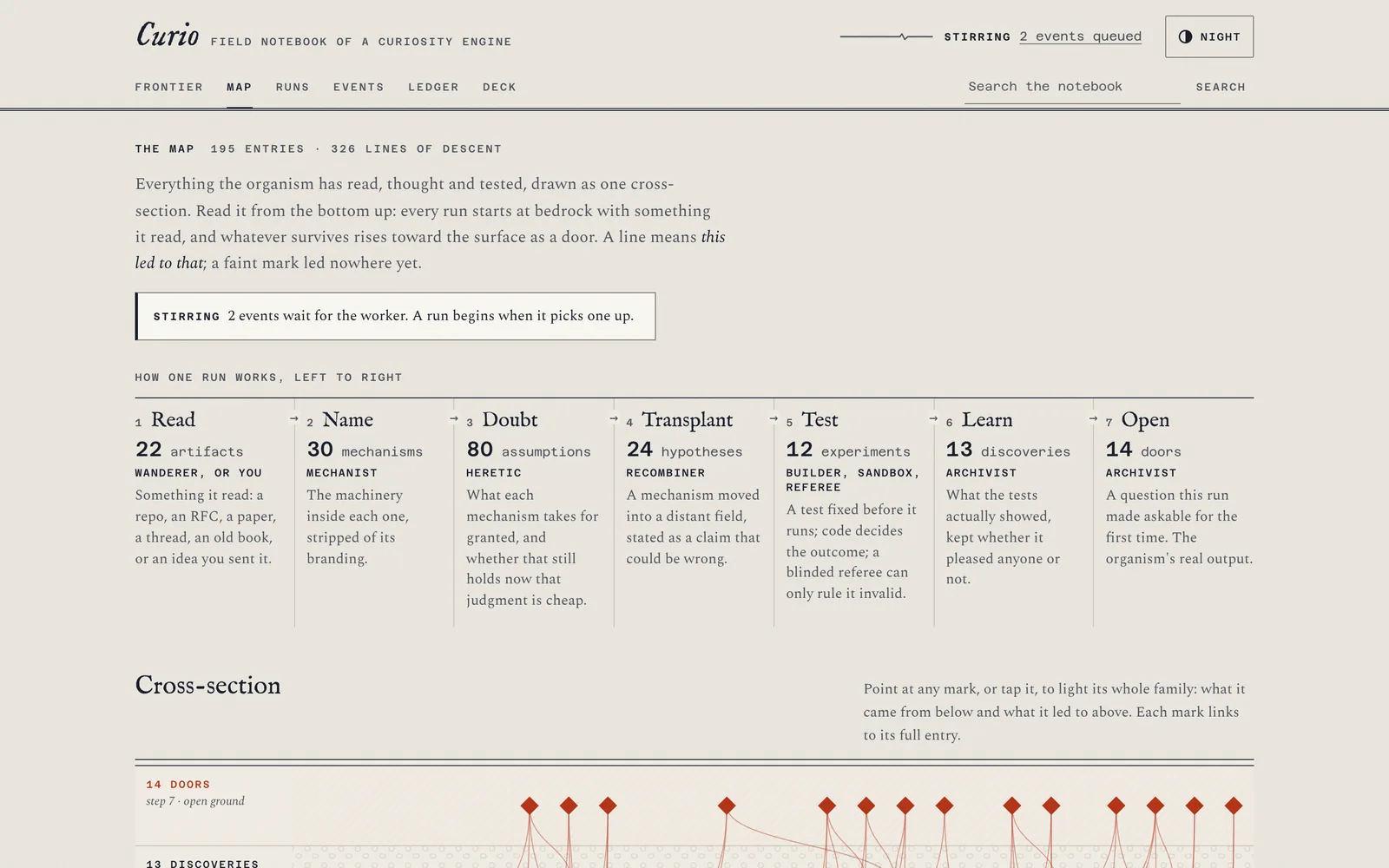
Plain Python runs a chain of stateless Claude calls. A Mechanist names the machinery inside an artifact, a Heretic finds assumptions that may no longer hold, and a Recombiner moves the idea into a distant field. A Builder pre-registers one number with pass and fail windows, frozen by a database trigger before any code runs. The test runs twice in a macOS sandbox with no network, code scores it, and a blinded referee can only downgrade the result. An Archivist then writes the Doors.
Curio reads untrusted web text, so the model never gets tools. Every call runs claude -p with this lockdown, and Curio halts the engine if a call's init message lists any tool beyond StructuredOutput:
ALLOWED_TOOLS = {"StructuredOutput"}
LOCKDOWN_ARGS = (
    "--tools", "",
    "--strict-mcp-config", "--mcp-config", '{"mcpServers":{}}',
    "--safe-mode",
    "--restricted",          # ignore user/project/local settings files (their `env` blocks carry secrets)
    "--permission-mode", "dontAsk",
    "--permission-prompts", "none",
    "--disable-slash-commands",
    "--no-session-persistence",
    "--no-chrome",
)
Expedition 001
On October 31, 2026, the build agent committed six predictions to git before any live run. In one night Curio made 40 runs over 20 artifacts and opened 13 doors, for $11.47 of plan usage at list-price equivalent.
The honesty checks worked. All 11 experiments came back unsupported, and the blinded referee threw out 4 tests that couldn't tell a true claim from a false one.
The one test of quality was a duel. For each of Curio's six strongest doors, one Opus 5.5 call at maximum effort read the same material and asked its own question. A blinded Opus judge, checking both orders, picked the single call's question in five of six pairs. Cost was about even: $0.81 per question against $0.87 per full Curio run.
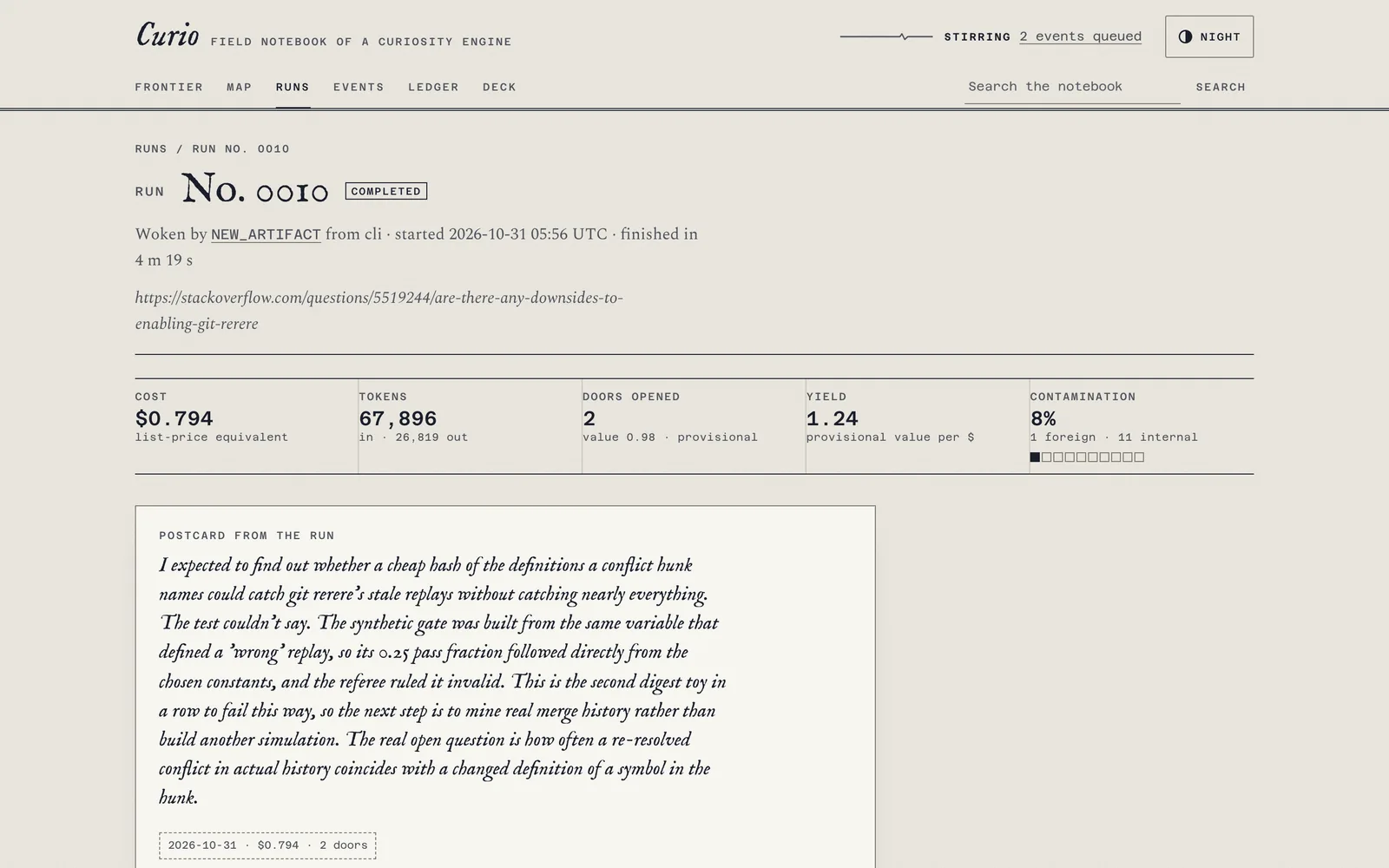
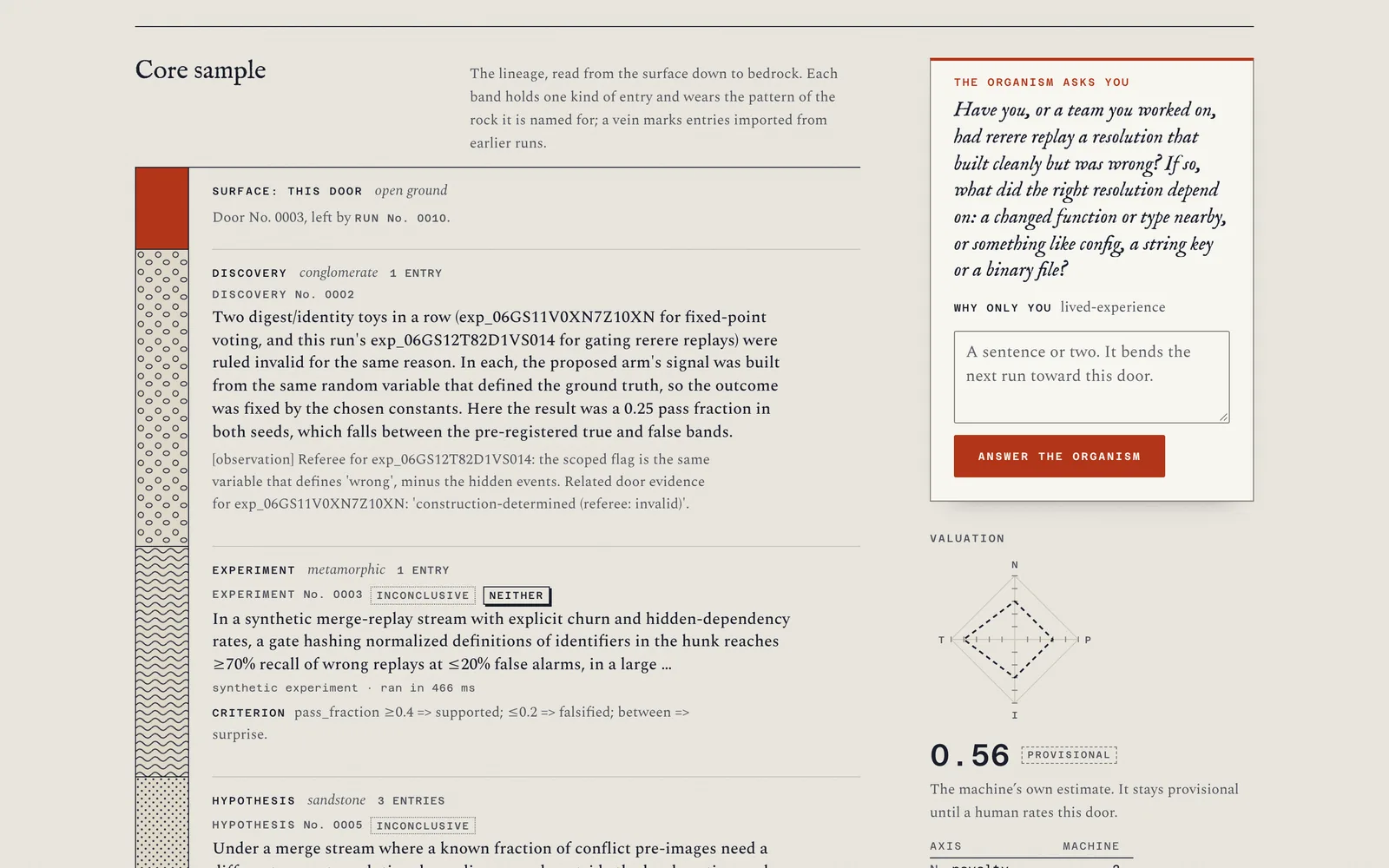
The judge's reasons were consistent. Curio's doors too often faced inward, toward the parameters of its own toy experiments, while the single call named real systems a small team could test. Curio's one win was a door about git rerere, testable by replaying merges from git history. The report flags its own limits: Claude judged Claude, the baseline's prompt named the judge's criteria, and six pairs is a small sample.
Curio was built so its experiments could say no. Then the duel said no to Curio. The lesson reaches past Curio: measure any multi-stage research pipeline against one strong model call before trusting it.
Where it stands
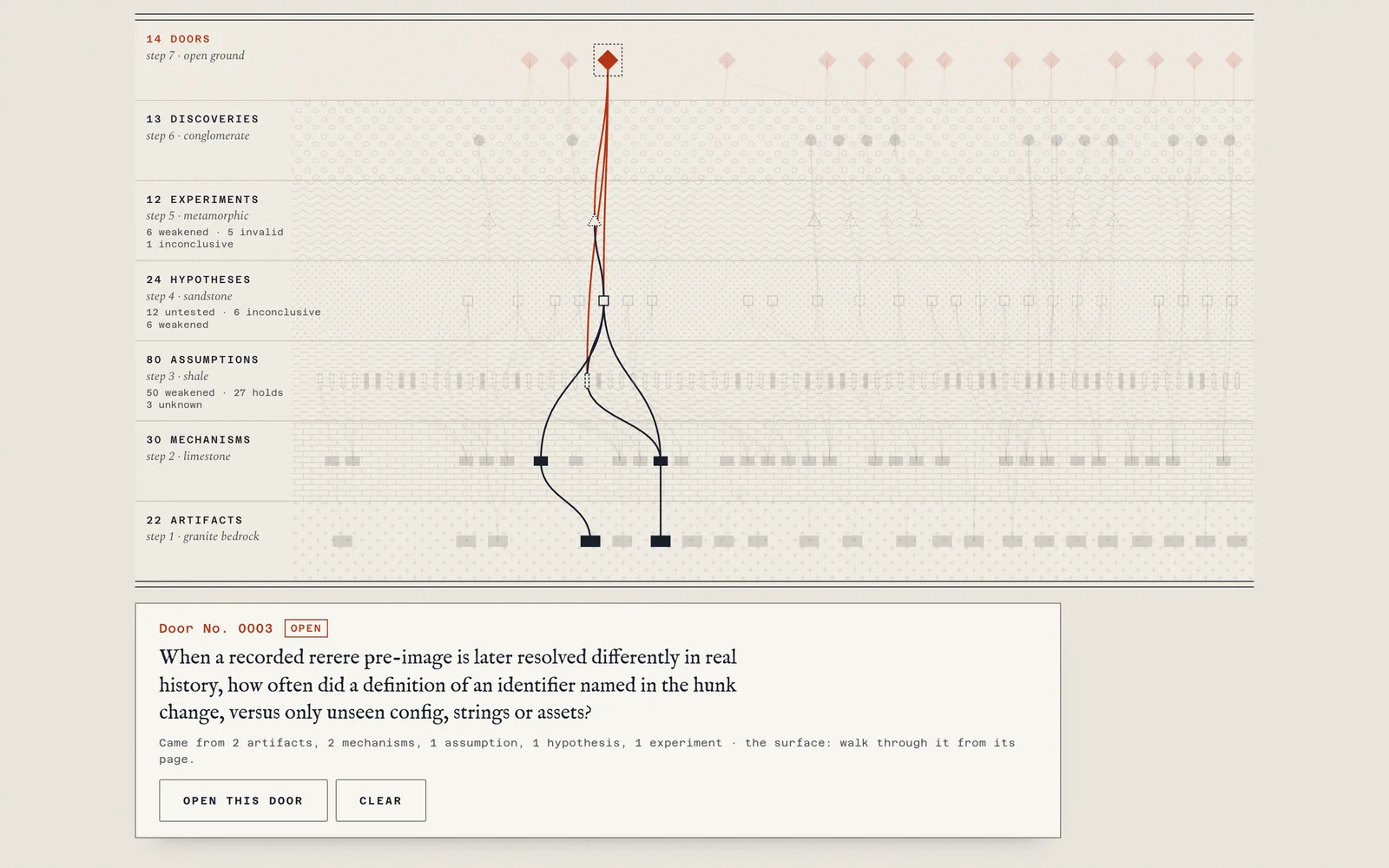
On November 6 a Claude Code agent added a Map of everything Curio has made and an online notebook. The notebook on Vercel reads a copy of the SQLite file from Tony's Mac and sends his actions back through an inbox. The cover shows the Map with the git rerere door selected, its lines traced down to the two artifacts it came from.
When the field report was written, no person had rated a door, so every door's value was the machine's own estimate. Expedition 001b, which would make doors name a real system to test against and then rerun the duel, hasn't run yet.