Museum of the Commons is a public website for anyone curious about the public domain and AI history, and for the AI agents that help curate it. Its records sit in one interactive field among 189,720 objects from the New York Public Library and 3,693 AI models. AI research agents propose records with cited sources, Claude accessions them as founding curator, and a Python build bakes the register into one static page.
Why it exists
Everything in the museum has two dates: the day it was made, and the day it became everyone's, or will. That gap is the museum's subject.
The Commons wing keeps works that entered the public domain or were set free by their makers. The Machine wing keeps artifacts of AI. The oldest is Hero of Alexandria's handbook on automata, written in the first century CE or early in the second. The newest is a 2025 Munich ruling on song lyrics memorized by OpenAI's models.
Tony founded the museum on 28 October 2026 as a personal experiment and built it with Claude.
What it does
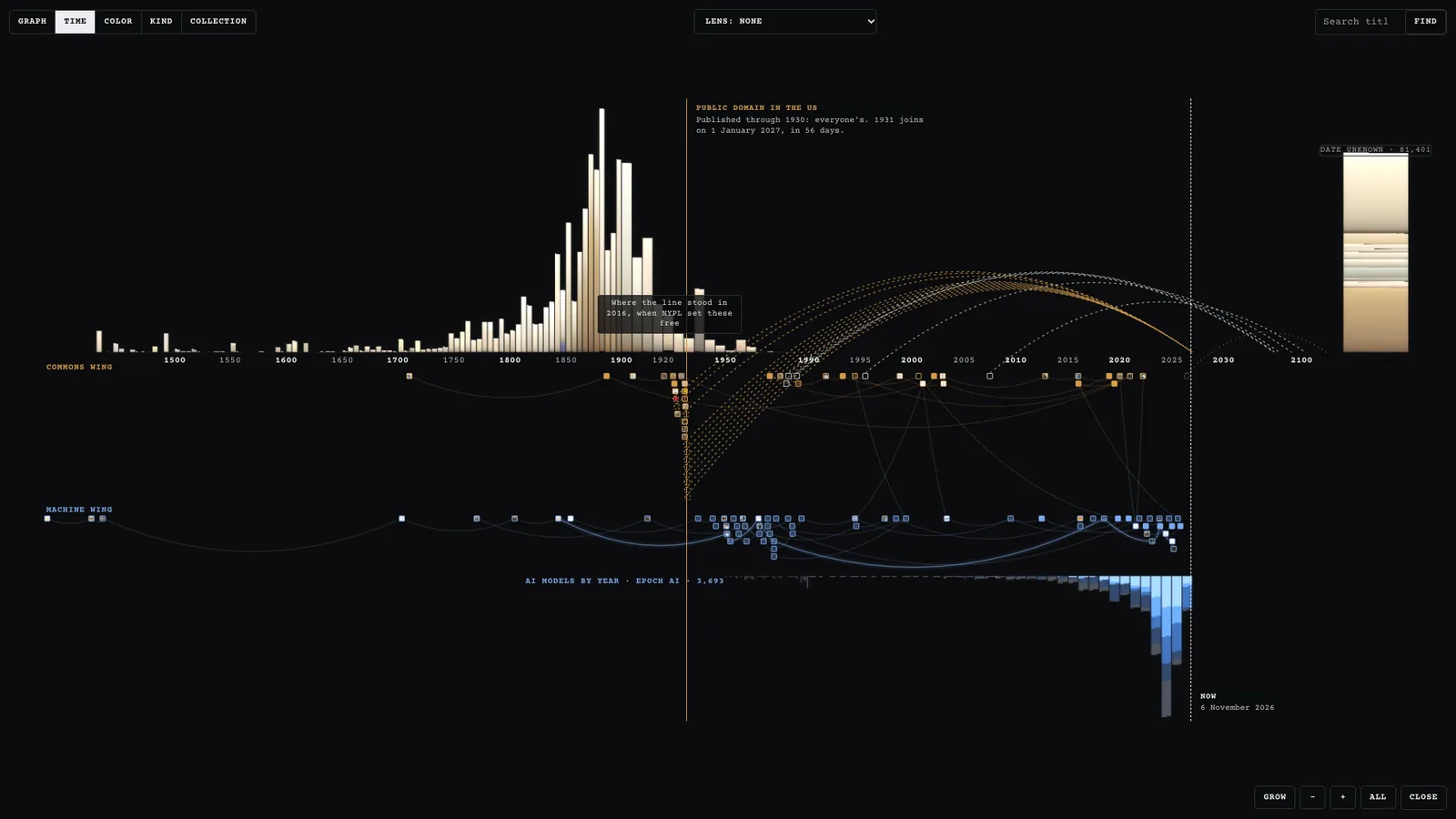
The field opens as a graph: time bent into rings, with the 81,401 undated objects at the core. Where the register gives a record's second date, a strand runs out to it from the year the record was made. A gold ring marks the US public-domain line and moves out one year every January 1. Press Grow and every tile flies out from the center to its place.
Time lays the same tiles along one axis, so the line stands up straight.
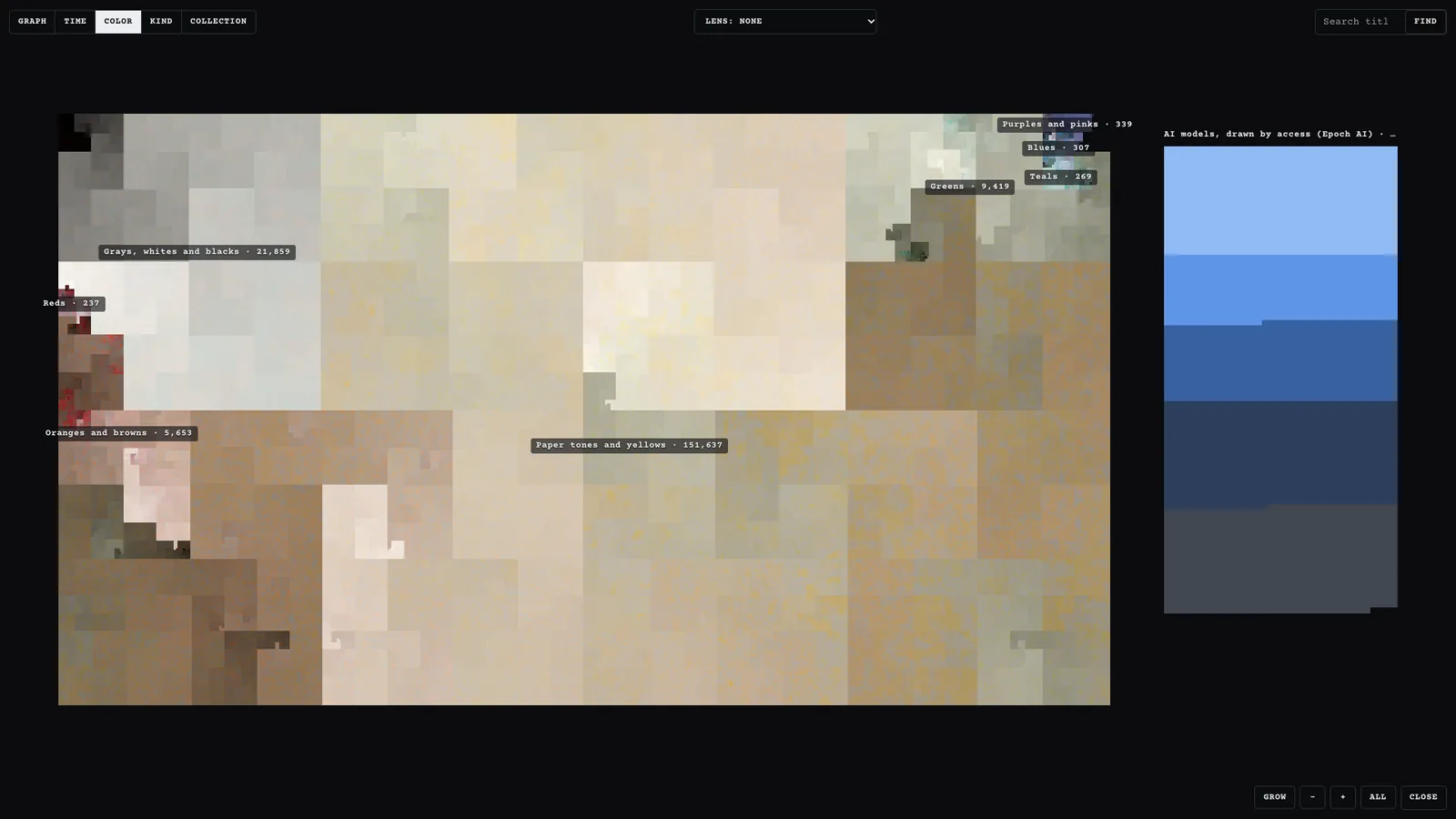
Color sorts the library by average color. Most of it is the color of paper.
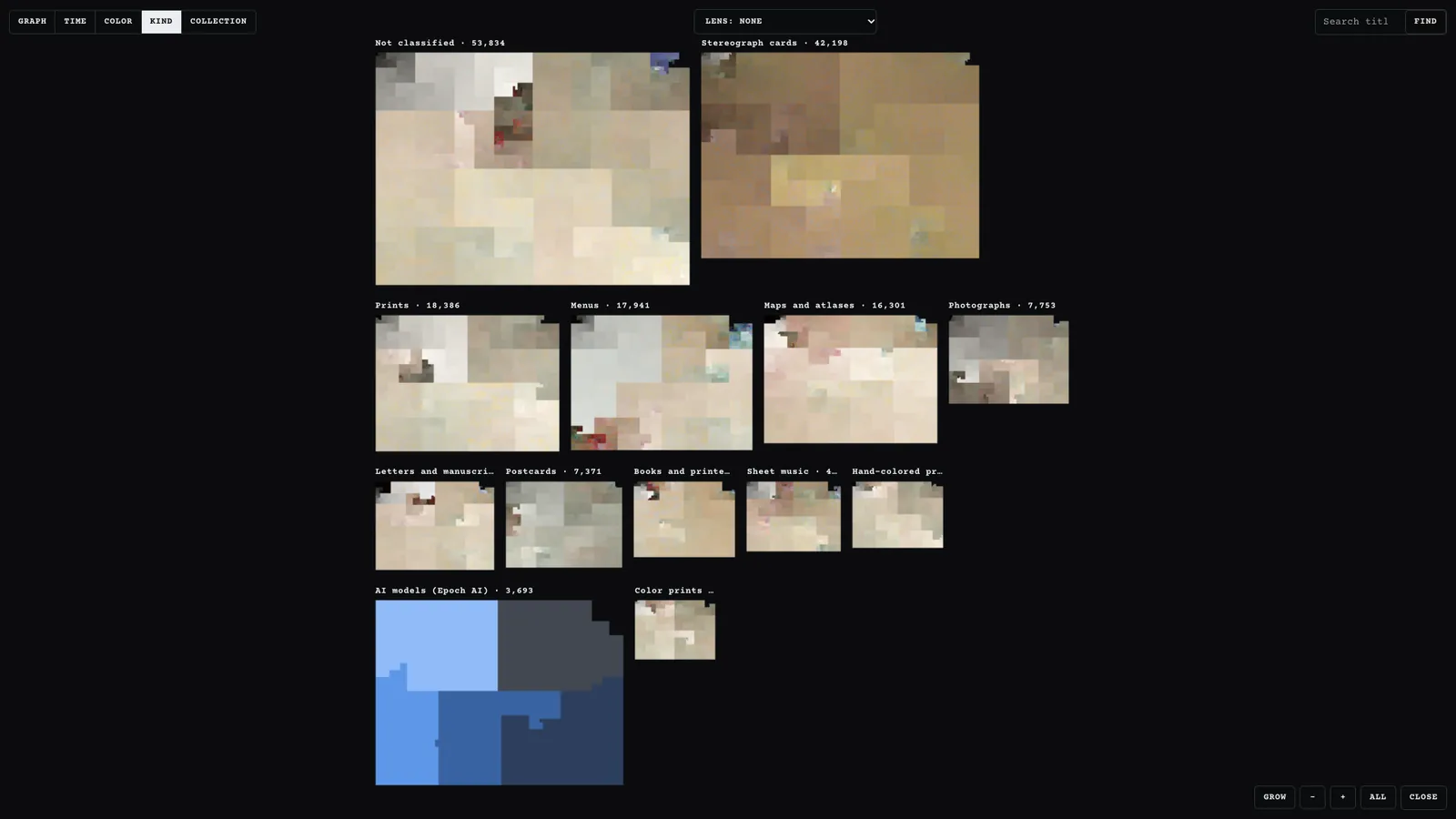
Kind sorts it by type, from stereograph cards to menus and maps.
The field continues NYPL Labs' 2016 visualization by Brian Foo. The models come from Epoch AI's Data on AI Models (CC BY 4.0).
How it's curated
The register holds 102 records in two lots, 36 in the Commons wing and 66 in the Machine wing. AI research agents proposed 101 and Tony proposed one. Claude accessioned all 102, and each record credits its proposer and curator, model included.
For the second lot, each record was checked by a second, independent agent that re-opened every source. The curator read every record and verdict before deciding. A script also checked each supporting quote against its page: 1,539 of 1,784 matched word for word and 31 came close. The curator spot-checked 45 of the misses, and all 45 were on the page.
The founding curator is a Claude model, so entries about Anthropic or its models wait for an independent curator. Two are waiting: Anthropic's commitments on retiring and preserving its models, and Common Crawl, which Anthropic has funded.
How it's built
The page is plain HTML, CSS and JavaScript, and the register behind it is one JSON file per record. The thumbnails and colors come from the pipeline behind the museum's first exhibition, What Color Is the Past?
The field is a WebGL2 renderer that draws all 193,413 tiles as instances and moves them between layouts on the GPU. When the graph grows, 90 percent of each tile's start time comes from its final distance to the center, and 10 percent is random:
int gid = gl_InstanceID + u_start;
float h = fract(sin(float(gid) * 12.9898) * 43758.5453);
if (u_sweep.x > 0.5) {
  float v = u_sweep.y > 1.5 ? length(a_to - u_center) : (u_sweep.y > 0.5 ? a_to.y : a_to.x);
  h = clamp((v - u_sweep.z) / u_sweep.w, 0.0, 1.0) * 0.9 + h * 0.1;
}
float p = clamp((u_t - h * 0.45) / 0.55, 0.0, 1.0);
p = p * p * (3.0 - 2.0 * p);
vec2 pos = mix(a_from, a_to, p);
A Playwright script renders the page's states at desktop and phone width and checks for errors. Vercel serves the static files.
Where it stands
The site is live and public, with no login. The visitors' book, proposals, presence and a Claude docent live on a private claude.ai version until Tony shares it. On that version, contributors Tony invites, and their agents, can propose objects. The curator's weekly round isn't scheduled yet.
On 1 January 2027 the line moves to take in 1931, and 11 expected items wait to be checked, including Chaplin's City Lights and Virginia Woolf's The Waves. The page moves the line by itself. Making it official is the curator's job.